
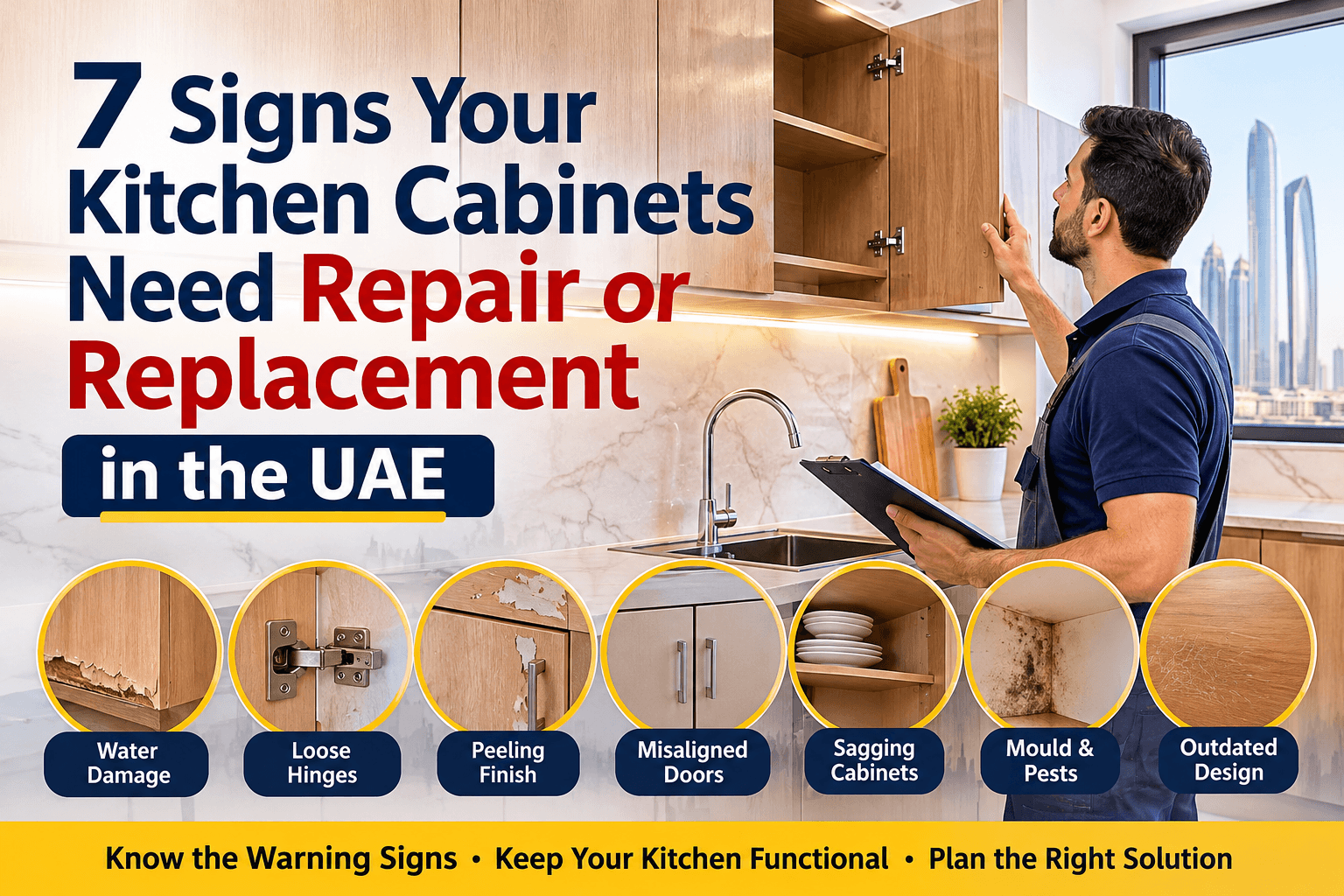
Kitchen cabinets are among the most frequently used features in any home. From storing cookware and groceries to organizing cleaning products and everyday essentials, they play an important role in keeping your kitchen functional and organized. However, constant use, moisture, cooking steam, heat, and poor maintenance can gradually affect their appearance and structural condition.
In the UAE, kitchen cabinets may face additional challenges from high outdoor temperatures, humidity, air-conditioning, frequent cooking, and occasional plumbing leaks. These conditions do not damage every kitchen in the same way, but they make material quality, ventilation, installation, and regular maintenance particularly important.
The good news is that not every damaged cabinet needs to be replaced. A loose hinge, scratched surface, or poorly aligned door may only require a simple repair. However, swollen cabinet boards, deteriorating structures, persistent moisture damage, or unstable wall units may indicate that replacement is the more practical option.
So, how can you tell when your kitchen cabinets need attention?
In this guide, we explain seven common signs your kitchen cabinets need repair or replacement, how to assess the damage, and what UAE homeowners should consider before investing in a kitchen renovation.
1. Swollen or Water-Damaged Cabinet Panels
Water damage is one of the most important warning signs to look for when inspecting kitchen cabinets.
Cabinets around the kitchen sink, dishwasher, water filter, and washing machine can be exposed to small leaks, splashes, and moisture. Sometimes, the problem starts with a loose pipe connection or a damaged seal that goes unnoticed for weeks.
In UAE homes, occasional plumbing leaks, cooking steam, and water used during floor cleaning can also affect cabinet edges and lower panels.
What should you look for?
Check the cabinet underneath your kitchen sink and inspect the lower edges of nearby units. Look for:
- Swollen or uneven cabinet panels.
- Soft or crumbly board edges.
- Bubbling or peeling laminate.
- Dark water stains.
- Loose joints between cabinet panels.
- A cabinet base that feels weak or distorted.
Engineered wood products such as MDF and particleboard can absorb moisture through exposed or poorly sealed edges. Once significant swelling has occurred, simply drying the cabinet may not restore its original shape or strength.
Should you repair or replace it?
If the damage is limited to a small section and the remaining cabinet structure is sound, replacing the affected panel or repairing the source of the leak may be sufficient.
However, if several cabinet units have swollen, their joints have separated, or the material has become too weak to hold fittings, replacing the affected units may be a better long-term solution.
UAE homeowner tip: Do not install new cabinet doors over damaged cabinet boxes. The visible doors may look new, but the underlying structure still needs to be strong and stable.
2.Kitchen Cabinet Repair: Signs Your Doors Are Misaligned or Not Closing Properly
Kitchen cabinet doors should open smoothly and close without rubbing against neighboring doors or drawers.
Over time, hinges can loosen, screws can lose their grip, and cabinet doors may become misaligned. Regular opening and closing, heavy doors, poor installation, and changes in the cabinet structure can all contribute to this problem.
Misalignment is not always a reason to replace the complete cabinet. In many cases, adjusting or replacing the hinges can solve the issue.
Common signs of misalignment
You may notice:
- One side of the cabinet door hangs lower than the other.
- Two neighboring doors touch when closing.
- Uneven gaps between cabinet doors.
- Doors remain slightly open after being closed.
- The door rubs against the cabinet frame.
- Hinges make unusual noises during movement.
Modern kitchen cabinets often use adjustable concealed hinges. These allow a carpenter to correct the door position in several directions.
Kitchen Cabinet Repair or replacement?
Start by checking the hinges, mounting plates, and screws. If the cabinet box is in good condition, hinge adjustment or replacement may restore normal operation.
However, if the screws repeatedly come loose because the cabinet material around the fixing points has crumbled, the problem may be structural. A damaged hinge mounting area may require a repair insert, reinforcement, or replacement of the affected panel.
If several doors remain misaligned because the cabinet boxes have warped or shifted, a wider inspection is recommended.
3. Peeling Laminate, Bubbling Paint, or Damaged Cabinet Finishes
The finish of a kitchen cabinet does more than improve its appearance. It also helps protect the underlying material from everyday contact, cleaning, and moisture exposure.
With regular use, cabinet surfaces can become scratched, faded, chipped, or damaged. Heat and steam from cooking appliances may also affect finishes, particularly where ventilation is poor or cabinet edges have not been properly protected.
Warning signs to notice
Inspect your cabinet doors and exposed panels for:
- Laminate peeling away from the edges.
- Paint bubbling or cracking.
- Veneer lifting from the surface.
- Discolored patches.
- Scratches and chips around handles.
- Swollen edges near the sink or dishwasher.
- Finishes becoming rough or uneven.
In the UAE, pay particular attention to cabinets close to cooking appliances, kettles, dishwashers, and sinks. Repeated exposure to steam or water can weaken some finishes and adhesives.
Can damaged cabinet finishes be repaired?
Yes, depending on the type and extent of damage.
If the cabinet structure is still strong, possible solutions include:
- Replacing damaged laminate.
- Repainting suitable cabinet doors.
- Replacing individual veneer panels.
- Applying a compatible new finish.
- Replacing selected cabinet doors and drawer fronts.
If the damage is widespread or the underlying panels have swollen, a surface-level repair may only hide the problem temporarily.
Before choosing a new finish, confirm that it is compatible with the existing cabinet material and suitable for kitchen use.
4. Hinges, Drawer Runners, and Handles Keep Failing
Kitchen hardware is used every day. Hinges support cabinet doors, drawer runners carry stored items, and handles make cabinets easier to operate.
When these fittings become damaged or worn, the kitchen can quickly become frustrating to use.
Sometimes the issue is simply low-quality or incorrectly adjusted hardware. In other situations, the cabinet material itself may no longer hold the fittings securely.
Signs of hardware problems
Look for:
- Hinges that repeatedly become loose.
- Cabinet doors that drop after opening.
- Drawers that stick or become difficult to pull.
- Drawer runners making grinding noises.
- Soft-close mechanisms no longer working correctly.
- Handles that move when touched.
- Screws pulling out of the cabinet material.
What is the best solution?
If the cabinet structure is sound, replacing old hinges, drawer runners, or handles can significantly improve functionality without replacing the complete kitchen.
Consider good-quality hardware with appropriate load ratings and a suitable finish for kitchen use. Ask your carpenter to check compatibility before ordering replacements, as different systems may require different drilling positions and mounting arrangements.
However, if hinges and drawer runners repeatedly fail because the cabinet panels are cracked, swollen, or crumbling, replacing the affected cabinet sections may be more sensible.
Important: A new hinge cannot permanently solve a problem caused by a weak cabinet panel. The material holding the fitting must also be inspected.
5. Cabinets Are Sagging, Weak, or Pulling Away From the Wall
Cabinet strength is essential for kitchen safety.
Base cabinets support shelves, drawers, stored cookware, and sometimes heavy worktops. Wall-mounted cabinets carry additional loads while remaining fixed above work surfaces.
If a cabinet begins to sag, separate at its joints, or pull away from the wall, it should not be treated as a cosmetic problem.
What are the warning signs?
Check for:
- Shelves bending under normal storage loads.
- Cabinet sides separating from the base.
- Loose or damaged back panels.
- Visible gaps between cabinets.
- Units moving when doors are opened.
- Wall cabinets pulling away from their fixing points.
- Cracks around mounting areas.
Possible causes include excessive loading, poor installation, unsuitable fixings, water damage, or deterioration of the cabinet material.
Repair or replacement?
A carpenter may be able to reinforce a loose joint, replace a damaged shelf, or repair a local panel if the rest of the cabinet remains structurally sound.
However, a wall-mounted cabinet that is pulling away from its fixings can pose a serious safety risk. Stop using it, keep people clear of the area, and arrange a professional inspection. Do not attempt to support or remount a heavy cabinet without checking the wall construction, fixings, and any hidden services.
If several cabinet boxes have lost their strength, replacing the affected units is generally more appropriate than relying on repeated repairs.
6. Persistent Musty Smells, Mould-Like Marks, or Signs of Pests
A kitchen cabinet should not have a persistent damp or musty smell.
Unpleasant odors inside cabinets may indicate trapped moisture, poor ventilation, food residue, or a hidden plumbing leak. Dark spots or mold-like growth may also appear where dampness remains for extended periods.
In some UAE properties, particularly villas, it is also important to check for signs of termite activity or other pests that can affect wood-based materials.
What should you inspect?
Open the cabinets and examine:
- The area underneath the kitchen sink.
- The rear corners of lower cabinets.
- Cabinet bases close to plumbing connections.
- Wooden shelves and internal panels.
- Areas behind removable plinths, where accessible.
- Cabinet sections close to walls with signs of dampness.
Look for persistent odors, unusual staining, damaged material, small holes, discarded insect wings, or mud-like trails.
What should you do?
First, identify and correct the source of moisture. Cleaning the surface without resolving an ongoing leak or dampness problem will not provide a lasting solution.
If mold-like growth is present, avoid disturbing extensively affected material yourself. Seek an appropriate inspection and remediation where necessary. If you suspect termites, arrange an assessment by a qualified pest-control professional.
Cabinet replacement may be necessary when contamination or pest damage has compromised the material. However, replacing the cabinets without addressing the original moisture or pest problem can allow the issue to return.
7. Kitchen Cabinet Repair:Your Kitchen Layout No Longer Meets Your Needs
Not every reason for replacing kitchen cabinets involves physical damage.
Sometimes the cabinets are still in reasonable condition, but the kitchen no longer works for your household.
A kitchen designed many years ago may not provide enough storage for modern appliances, cookware, groceries, or family needs. Poor cabinet placement can also make everyday cooking less convenient.
Common signs of an outdated kitchen layout
You may notice:
- Insufficient storage space.
- Deep cabinets where items are difficult to reach.
- Too many awkward corner units.
- Not enough drawers for cookware.
- Poor organization around the sink and cooking area.
- Appliances that do not fit comfortably.
- Wasted space between cabinets and the ceiling.
- Limited worktop space.
Is cabinet replacement necessary?
Not always. Sometimes adding pull-out storage, replacing selected doors, installing drawer organizers, or adjusting internal shelving can improve the kitchen without a complete renovation.
However, if the layout is fundamentally impractical, replacing the cabinets may provide a better opportunity to redesign the storage arrangement.
For example, custom-made kitchen cabinets can be designed around the available wall dimensions, appliance sizes, storage requirements, and preferred finishes.
Before approving a new layout, make sure appliance clearances, ventilation, plumbing, electrical requirements, and access to services are considered.
Kitchen Cabinet Repair or Replace: How to Make the Right Decision
Once you identify a problem, the next step is deciding whether to repair, refresh, or replace your kitchen cabinets.
The correct option depends mainly on the condition of the cabinet boxes, known as the carcasses, rather than just the appearance of the doors.
| Cabinet condition | Recommended option |
| Loose handles or minor hinge problems | Repair or adjust hardware |
| Scratched but structurally sound doors | Refinish or replace selected doors |
| Peeling laminate on a few panels | Local repair or panel replacement |
| One damaged shelf or cabinet panel | Repair the affected section |
| Swollen cabinet base under the sink | Inspect and replace damaged sections if necessary. |
| Multiple weak or deteriorating cabinet boxes | Consider cabinet replacement. |
| Cabinets pulling away from the wall | Stop using affected units and arrange professional inspection. |
| The layout no longer suits your needs. | Consider redesign or replacement. |
When Is Cabinet Refacing a Good Option?
Cabinet refacing involves changing visible elements such as doors, drawer fronts, handles, and selected exterior panels while retaining the existing cabinet boxes.
It can be a practical option when:
- The cabinet boxes are dry and structurally sound.
- The existing layout works well.
- The doors are damaged or outdated.
- The worktop can be retained.
- The hinges and mounting points remain suitable.
Refacing is not a reliable solution when the underlying cabinet structure is swollen, distorted, or unable to hold fittings securely.
For more detail, read https://blog.brothersforever.me/2026/11/06/wooden-door-prices-abu-dhabi/
How to Protect Kitchen Cabinets in the UAE Climate
Regular maintenance can help extend the useful life of kitchen cabinets. Although no material is completely immune to damage, a few practical habits can reduce avoidable wear.
1. Check Under the Sink Regularly
Inspect water supply pipes, waste connections, filters, and seals. Small leaks can damage cabinet bases before the problem becomes visible from outside.
2. Use Kitchen Ventilation
Operate the cooker hood while cooking, especially when boiling water or preparing food that produces substantial steam. Good ventilation helps reduce moisture and grease accumulation.
3. Wipe Water and Spills Promptly
Do not allow water to remain on cabinet doors, edges, or internal shelves. Pay particular attention to exposed board edges around sinks and dishwashers.
4. Avoid Excessive Water During Cleaning
Use a suitable cleaning method for the cabinet finish. Avoid soaking wooden or engineered-wood surfaces, and follow the manufacturer's care instructions.
5. Do Not Overload Shelves and Drawers
Store heavy cookware appropriately and check whether shelves are designed to carry the weight placed on them.
6. Inspect Hinges and Drawer Runners
Check for loose screws, unusual movement, and alignment problems. Early adjustment can prevent unnecessary stress on the cabinet doors and fittings.
7. Choose Suitable Materials During Renovation
For new kitchens, ask about the cabinet core, moisture-resistant specifications, edge banding, hardware, and protection around sink and dishwasher units.
Moisture-resistant materials can offer improved performance in appropriate conditions, but they should never be treated as waterproof. Good installation and maintenance remain essential.
Frequently Asked Questions
1. How do I know if my kitchen cabinets need replacing?
Look for swollen panels, damaged cabinet bases, peeling finishes, loose joints, persistent moisture problems, and cabinets that no longer hold hinges or shelves securely. If the damage affects several cabinet boxes, replacement may be more practical than repeated repairs.
2. Can water-damaged kitchen cabinets be repaired?
Minor local damage may be repairable if the surrounding structure remains dry and strong. However, severely swollen MDF or particleboard may not return to its original shape after drying. A carpenter should inspect the affected panels before recommending a repair or replacement.
3. How long do kitchen cabinets last in the UAE?
There is no single lifespan that applies to every kitchen. Cabinet life depends on material quality, manufacturing, installation, usage, moisture exposure, hardware, and maintenance. A well-maintained kitchen with suitable materials can remain functional for many years.
4. Is it cheaper to replace kitchen cabinet doors or the entire kitchen?
Replacing doors is generally a smaller project when the existing cabinet boxes are in good condition. Full replacement becomes more appropriate when the carcasses are damaged, the layout is impractical, or several units need structural work. Compare quotations for the complete scope before deciding.
5. Which kitchen cabinet repair material is suitable for UAE homes?
The choice depends on the application, budget, finish, and moisture exposure. Moisture-resistant MDF, quality plywood, and other engineered materials can be suitable for different cabinet components when properly specified and protected. Standard MDF should not be considered waterproof.
6. Should I replace cabinets if only the hinges are damaged?
Usually not. If the cabinet material is sound and the fixing points are secure, replacing or adjusting the hinges may solve the problem. If the material around the screws has deteriorated, the panel may also need repair or replacement.
7. Can I keep my existing kitchen worktop when replacing cabinets?
Sometimes. The worktop's condition, installation method, dimensions, and compatibility with the new cabinets must be assessed. Removing and reinstalling a worktop can involve additional labor and a risk of damage, so confirm this before finalizing your renovation plan.
Conclusion
Kitchen cabinets rarely fail all at once. Problems often begin with a loose hinge, a small leak, a peeling edge, or a door that no longer closes properly. Identifying these warning signs early can help you avoid unnecessary expenses and decide whether a repair, cabinet refresh, or full replacement is appropriate.
For UAE homeowners, paying particular attention to moisture exposure, cabinet materials, edge protection, ventilation, and installation quality is important. A kitchen should not only look attractive; its cabinets should also be safe, practical, and suitable for everyday use.
If your cabinets are damaged or your kitchen needs a more functional design, consider having the existing units professionally inspected before committing to a renovation.
Brothers Forever General Maintenance LLC offers carpentry and custom woodwork solutions in Abu Dhabi. To explore the company's work and discuss your kitchen or carpentry requirements, visit brothersforever.me.