
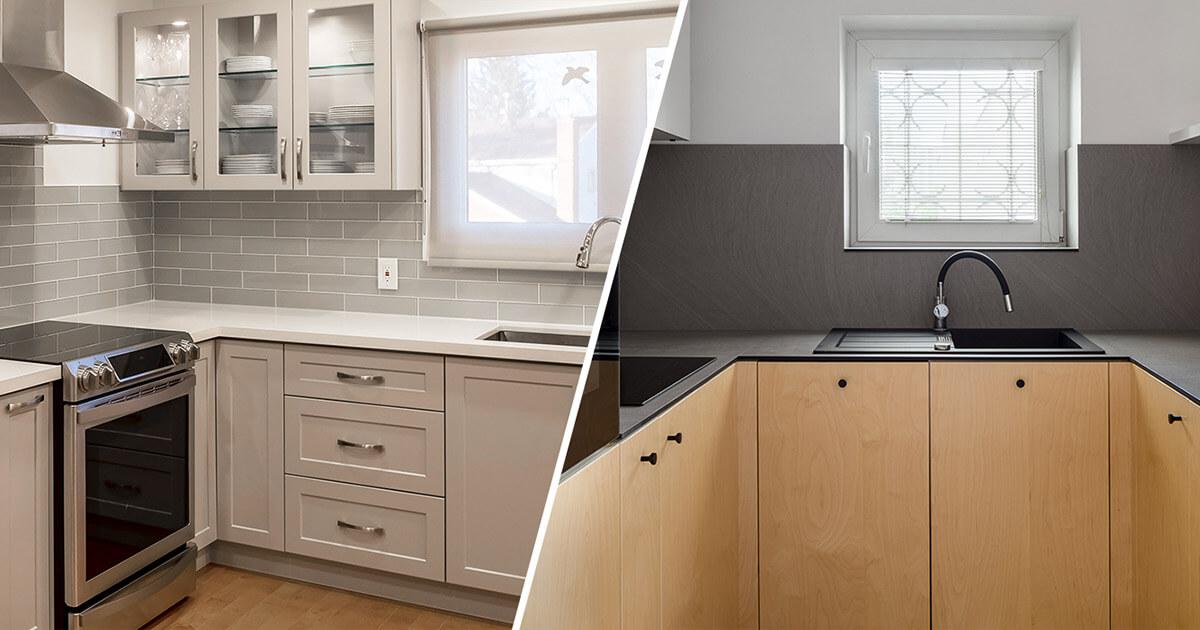
Choosing the right material is one of the most important decisions when designing or renovating a kitchen. The material used for kitchen cabinets affects their appearance, structural performance, maintenance requirements, and ability to withstand everyday use. For homeowners in the UAE, where kitchens experience frequent cleaning, cooking steam, air-conditioning cycles, and occasional water exposure, selecting suitable cabinet materials is particularly important.
Two commonly considered options are medium-density fiberboard (MDF) and plywood. Both are engineered wood products used in modern kitchen cabinetry, but they have different manufacturing processes, physical properties, and practical applications.
So, which is better for kitchen cabinets in the UAE: MDF or plywood?
MDF is often a practical choice for smooth, painted, and decorative cabinet doors, while good-quality plywood is generally preferred for applications requiring stronger screw-holding performance and structural support. However, neither material is automatically waterproof, and the quality of the board, edge protection, hardware, and installation can make a significant difference.
This guide compares MDF and plywood in detail to help UAE homeowners make an informed decision before investing in a new kitchen.
1. What Is MDF? Understanding Medium-Density Fibreboard
Medium-Density Fibreboard, commonly known as MDF, is an engineered wood panel manufactured using refined wood fibers combined with resin and other additives. These materials are compressed under controlled heat and pressure to produce a dense, uniform sheet.
Unlike natural timber, MDF does not have visible wood grain, knots, or the same variations found in solid wood. Its smooth and consistent surface makes it particularly suitable for modern kitchen designs.
Main characteristics of MDF
- Smooth surface: Provides a consistent base for painting, laminating, and decorative finishes.
- Uniform construction: Does not have the natural grain variations found in timber.
- Design flexibility: Can be machined into different profiles and decorative patterns.
- Consistent thickness: Supports precise cutting and manufacturing.
- Cost considerations: Standard MDF is often more economical than premium cabinet-grade plywood.
- Moisture sensitivity: Can swell when water enters unprotected edges or damaged surfaces.
Where is MDF used in kitchen cabinets?
MDF is frequently used for:
- Flat-panel kitchen cabinet doors.
- Shaker-style cabinet doors.
- Painted and lacquered finishes.
- Decorative wall panels.
- Drawer fronts.
- Cabinet end panels.
- Decorative kitchen features.
Its smooth surface is particularly useful when a homeowner wants a uniform painted finish or a contemporary kitchen design.
What is moisture-resistant MDF?
Moisture-resistant MDF, often identified as MR MDF, is manufactured with a resin formulation designed to improve its resistance to humid conditions compared with standard MDF.
It can be suitable for selected kitchen applications when properly finished and installed. However, moisture-resistant MDF should not be described as waterproof. Prolonged water exposure, leaking plumbing, and unsealed cut edges can still cause swelling and damage.
For UAE kitchens, it is important to confirm whether a contractor is specifying standard MDF or a moisture-resistant grade rather than accepting the general description of MDF.
2. What Is Plywood? Understanding Its Construction and Properties for MDF vs plywood kitchen cabinets UAE
Plywood is an engineered wood panel manufactured by bonding several thin layers of timber veneer together. The grain direction of neighbouring layers is generally arranged at right angles, creating a cross-laminated structure.
This construction gives plywood useful structural properties, including strength, stiffness, and good screw-holding performance when an appropriate grade is selected.
Main characteristics of plywood
- Layered construction: Made from bonded timber veneers.
- Structural strength: Generally offers good strength for cabinet structures and shelving.
- Screw-holding performance: Often performs better than MDF at repeated fixing points and near panel edges.
- Different grades: Available in various thicknesses, veneer qualities, and core constructions.
- Natural appearance: Can be finished with veneer or other surface materials.
- Variable quality: Performance depends on the timber, adhesive, number of layers, and internal construction.
Where is plywood used in kitchen cabinets?
Plywood is commonly used for:
- Cabinet carcasses and structural boxes.
- Heavy-duty shelving.
- Tall pantry units.
- Drawer structures.
- Sink-base cabinets.
- Cabinet sections supporting heavier loads.
However, not every plywood sheet is suitable for kitchen cabinetry. Low-grade products may contain internal gaps, inconsistent veneers, or weak bonding. These issues can affect machining, edge quality, and hardware fixing.
For this reason, the plywood grade, thickness, and intended application should always be specified in the quotation.
3. MDF vs Plywood: Detailed Comparison for UAE Kitchens
Understanding the differences between these materials can help homeowners select the appropriate option for individual kitchen components.
| Comparison factor | MDF | Plywood |
| Manufacturing | Compressed wood fibres | Cross-bonded timber veneers |
| Surface quality | Smooth and uniform | Natural veneer surface |
| Painted finishes | Excellent base for painting | Requires suitable surface preparation |
| Decorative profiles | Suitable for detailed machining | Depends on veneer and panel construction |
| Structural strength | Suitable for many cabinet applications | Generally stronger for structural applications |
| Screw holding | Requires appropriate fixings | Generally better, particularly at edges |
| Moisture response | Standard MDF can swell significantly. | Usually more tolerant, but can still swell or delaminate. |
| Weight | Generally dense and relatively heavy | Varies by species, grade, and thickness |
| Cost | Often more economical | Good-quality cabinet plywood often costs more. |
| Common applications | Painted doors and decorative panels | Cabinet structures, shelves, and heavier-duty components |
These are general comparisons rather than guarantees. Poorly manufactured plywood may perform worse than correctly specified MDF. Similarly, the correct board thickness and fixing system are important regardless of material.
4. Which Material Is Better for the UAE Climate? MDF vs plywood kitchen cabinets UAE
Climate and moisture exposure matter when selecting kitchen cabinet materials in the UAE.
Homes in Abu Dhabi, Dubai, Sharjah, and other emirates commonly use air-conditioning for much of the year. However, kitchen cabinets are still exposed to moisture from cooking, washing, cleaning, plumbing, and appliances.
Some of the most common sources of moisture exposure include:
- Water splashes around kitchen sinks.
- Leaking water supply or drainage connections.
- Steam from cooking activities.
- Dishwasher heat and moisture.
- Condensation around plumbing connections.
- Water entering through damaged countertop joints.
- Wet cleaning around cabinet bases.
The important distinction is between general indoor humidity and direct water exposure. Even a high-quality cabinet board can deteriorate if water repeatedly enters an exposed edge or damaged joint.
MDF performance in UAE kitchens
Standard MDF can absorb water through exposed edges, drilled holes, and damaged finishes. Once significant swelling occurs, the board generally does not return to its original shape.
Moisture-resistant MDF provides improved resistance to humid conditions, making it a possible option for selected indoor kitchen applications.
For better performance, homeowners should ensure that:
- The correct MDF grade is specified.
- Exposed edges are properly sealed.
- Laminates or painted finishes are applied correctly.
- Sink and dishwasher areas receive additional protection.
- Plumbing connections are checked regularly.
Plywood performance in UAE kitchens
Quality plywood generally offers better structural strength and may tolerate occasional moisture exposure better than standard MDF.
However, plywood is not waterproof. Water can enter through exposed edges, poor-quality veneer faces, and damaged joints. Repeated moisture exposure can also affect the adhesive bonding between layers.
Its performance depends on the quality of the plywood, the adhesive used, the finish, and the quality of installation.
Practical recommendation: For kitchens in the UAE, material selection should be based on the location and function of each cabinet rather than assuming that one material is suitable for the entire kitchen.
5. MDF vs plywood kitchen cabinets UAE Doors
Cabinet doors are among the most visible elements of a kitchen. Their surface quality, color consistency, and finish contribute significantly to the overall appearance.
Advantages of MDF cabinet doors
MDF is particularly suitable for painted cabinet doors because its uniform surface provides a consistent base for different finishes.
It is often used for:
- Modern flat-panel doors.
- Matte-finish kitchen doors.
- High-gloss painted designs.
- Shaker-style doors.
- Decorative routed panels.
- Custom-designed cabinet fronts.
MDF can also be machined to create decorative profiles without the natural grain variations associated with solid timber.
Advantages of plywood cabinet doors
Plywood can be suitable when the homeowner prefers a natural wood appearance or a veneer-based finish.
However, the visible surface quality depends on the face veneer and the manufacturing grade. Additional preparation may be necessary when a highly uniform painted finish is required.
Which should you choose?
For smooth painted or routed kitchen cabinet doors, quality MDF is often a practical option. For natural wood-look finishes, veneered plywood may be worth considering.
The final decision should also account for door size, hinge requirements, finish durability, and expected daily use.
6. MDF vs Plywood for Cabinet Carcasses and Shelves
The cabinet carcass is the structural framework behind the doors and drawers. It supports the storage compartments, shelves, hinges, and other fittings.
Unlike decorative cabinet fronts, the carcass must be designed to handle the weight of stored kitchen items and, depending on the construction, the loads associated with worktops and appliances.
Plywood is often preferred for structural applications because of its stiffness and screw-holding performance.
It may be particularly useful for:
- Large pantry cabinets.
- Long shelves.
- Heavy storage units.
- Cabinet structures requiring repeated hardware fixing.
- Sections supporting heavier drawer systems.
MDF can also be used for cabinet carcasses when the appropriate grade, thickness, support design, and fixing methods are selected.
Why shelf thickness matters
A shelf that is too long or too thin may bend when loaded with cookware, food containers or kitchen appliances.
The performance of a shelf depends on several factors:
- Board material and quality.
- Board thickness.
- Distance between support points.
- Weight and distribution of stored items.
- Type of shelf brackets or supports.
A well-designed kitchen should account for these factors during the planning and manufacturing stages.
7. Can MDF and Plywood Be Combined in One Kitchen?
Yes. Using both materials in the same kitchen can be a practical way to balance cost, appearance, and structural requirements.
Rather than selecting one material for every component, a carpenter can specify materials according to their intended use.
For example:
| Kitchen component | Possible material choice |
| Painted cabinet doors | Quality MDF |
| Shaker-style cabinet fronts | MDF |
| Decorative panels | MDF |
| Structural cabinet carcasses | Quality plywood or suitable MDF |
| Heavy-duty shelves | Quality plywood |
| Drawer fronts | MDF or plywood, depending on finish |
| Sink-base cabinet | Suitable moisture-tolerant board with protected edges |
| Tall pantry units | Plywood or appropriately specified engineered board |
This approach avoids paying for premium material where it may not provide meaningful benefits while allowing stronger or more moisture-tolerant materials to be used where appropriate.
For example, a homeowner may choose MDF for the visible painted doors and plywood for selected structural components. The result can offer a refined appearance with practical construction.
8. How Much Does MDF or Plywood Cost for Kitchen Cabinets in the UAE?
The cost of kitchen cabinets in the UAE varies considerably depending on the supplier, board specification, kitchen dimensions, finish, and installation requirements.
There is no reliable universal price difference between MDF and plywood because contractors may quote different grades, thicknesses, and construction methods.
Generally, standard MDF is often more economical than premium cabinet-grade plywood. However, a comparison should always be based on equivalent specifications.
The following factors influence the final quotation:
Board grade and thickness
Standard MDF, moisture-resistant MDF, and different plywood grades have different material costs. Thicker panels may also increase the amount of material required.
Cabinet design
Simple flat-panel doors generally require less decorative machining than detailed or customized designs.
Surface finish
Laminate, melamine, veneer, acrylic, and painted finishes can have different material and labor costs.
Hardware
Soft-close hinges, drawer channels, pull-out baskets, handles, and specialized storage systems affect the overall price.
Fabrication and installation
Custom measurements, cutting, edge banding, assembly, transportation, and installation all contribute to the project cost.
How to compare quotations
When requesting quotations from UAE carpenters or kitchen contractors, ask them to provide:
- Exact board material and grade.
- Board thickness for each cabinet component.
- Door and carcass material specifications.
- Finish type and color.
- Hardware brand or specification.
- Installation and delivery charges.
- Countertop inclusions or exclusions.
- Warranty and after-sales terms.
This will help you compare quotations fairly rather than choosing a contractor based only on the lowest advertised price.
9. Common Mistakes to Avoid When Selecting Kitchen Cabinet Materials
Even good-quality materials can perform poorly if they are incorrectly specified or installed.
Choosing standard MDF for areas exposed to water
Standard MDF is not designed to withstand repeated direct water exposure. Use an appropriate grade and ensure that edges and cut-outs are protected.
Assuming all plywood is the same
Plywood quality varies according to the timber, core construction, adhesive, and manufacturing standards. Request the actual specification rather than relying on the product name.
Ignoring edge protection
Exposed edges are potential entry points for moisture. Proper edge banding, sealing, and finishing are important for both MDF and plywood.
Selecting hardware without considering the load
Large cabinet doors and heavily loaded drawers require suitable hinges and runners. Hardware should be selected according to the cabinet dimensions and expected use.
Focusing only on the visible finish
A kitchen may look attractive from the outside while using unsuitable materials or weak construction internally. Ask about the carcass, shelves, back panels, and fixing methods.
Not reviewing the final measurements
Incorrect measurements can lead to gaps, alignment problems, and unnecessary modifications during installation. Review the approved kitchen drawings before manufacturing begins.
10. How to Choose the Right Material for Your Kitchen: Homeowner Checklist
Before confirming a kitchen cabinet order, consider the following questions:
- Is the MDF standard or moisture-resistant?
- What grade of plywood will be used?
- What is the thickness of the cabinet doors and carcasses?
- Are the cabinet frames and doors made from different materials?
- How will exposed edges be protected?
- Which finish will be applied to the doors?
- Are the hinges and drawer channels suitable for the expected load?
- How will the sink and dishwasher cabinets be protected?
- Does the quotation include measurement, delivery, and installation?
- Are the final drawings approved before fabrication?
- What warranty and after-sales support are provided?
It is also advisable to inspect physical material samples before confirming your selection. This helps you evaluate the actual color, texture, thickness, and finish.
11. Frequently Asked Questions
Is MDF or plywood better for kitchen cabinets in the UAE?
MDF is often preferred for painted and decorative cabinet doors, while good-quality plywood is generally more suitable for structural components requiring stronger screw-holding performance. The best choice depends on the intended application and material quality.
Is moisture-resistant MDF waterproof?
No. Moisture-resistant MDF is designed to offer improved resistance to humid conditions compared with standard MDF. It can still swell when exposed to prolonged water contact or unprotected moisture.
Is plywood suitable for kitchen cabinets near the sink?
Good-quality plywood can be a suitable option for sink-base cabinets because of its structural properties and generally better tolerance of occasional moisture compared with standard MDF. However, exposed edges, plumbing cutouts, and joints still require protection.
Which material is better for modern kitchen designs?
MDF is often suitable for modern painted, matte, and high-gloss cabinet designs because of its smooth and consistent surface. Plywood can also be used with suitable laminate or veneer finishes.
Does plywood last longer than MDF?
Not necessarily in every application. Lifespan depends on board quality, construction, finish, installation, maintenance, and exposure to moisture. A properly manufactured MDF cabinet in a dry location may perform better than poorly constructed plywood cabinetry.
Can MDF and plywood be used together?
Yes. Combining materials is a practical option. MDF may be selected for painted doors and decorative panels, while plywood may be used for selected cabinet structures and heavier-duty shelves.
How can I identify good-quality kitchen cabinet materials?
Ask for the product grade, thickness, and technical specifications. Inspect samples, check edge quality, and confirm the finish and hardware details before approving the order.
Conclusion: Making the Right Choice for Your UAE Kitchen
Choosing between MDF and plywood is not simply a matter of deciding which material is stronger or cheaper. Both materials have advantages, and their suitability depends on the requirements of each kitchen component.
MDF is an attractive option for homeowners who want smooth painted finishes, decorative cabinet doors, and consistent designs. Plywood is worth considering for structural components, heavier shelves, and applications where good screw-holding performance is important.
For many UAE kitchens, combining the two materials can provide a practical balance between appearance, performance, and budget.
Before making your final decision, consider the kitchen layout, storage requirements, moisture exposure, board specifications, hardware, and installation quality. A carefully planned material specification can help you avoid unnecessary expenses and achieve a kitchen that remains functional and attractive over time.
Planning a custom kitchen or carpentry project in Abu Dhabi?
Brothers Forever General Maintenance LLC provides carpentry and general maintenance services, including custom kitchen cabinets, wooden doors, wardrobes, and furniture.
Visit brothersforever.me to learn more about the company's services and discuss your carpentry requirements.
For more details read: https://blog.brothersforever.me/2026/10/28/villa-maintenance-cost-dubai-2026/